
Printed circuit boards (pcb) are a vital necessity for technology companies of all stripes. For most hardware tech companies, pcb suppliers ship quickly. What they don’t take into consideration is that the actual assembly often takes a minimum of 10 days. That’s where the husband-and-wife team Praveen and Pam Arya stepped up back in 1993 – setting out to manufacture and ship pcbs in less time, serving as a one-stop shop for customers.
“We both worked for pcb companies in Vancouver before starting Canadian Circuits,” Pam says. “Our vision was to do something different. Most of our customers were saying that if we could do assembly, they wouldn’t have to go elsewhere. I kept bringing information to Praveen about how we could see success by providing assembly services.”

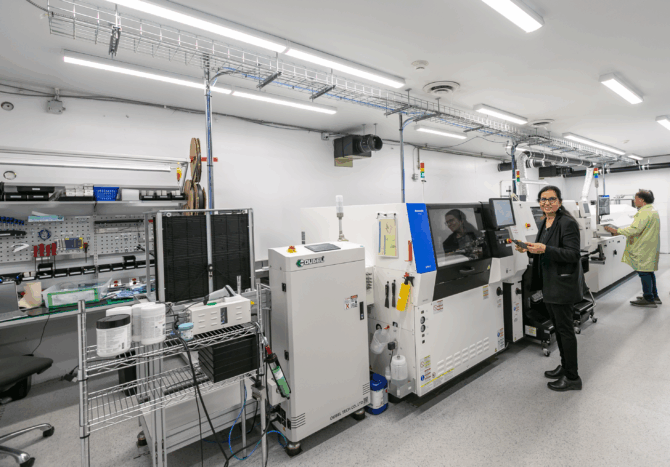
Pam Arya, co-founder of Canadian Circuits Inc. in Burnaby B.C. stands in one of the printed circuit board production areas. Source: CCI
Pam and Praveen started Canadian Circuits with the vision to produce boards overnight. pcb production, Praveen says, shouldn’t take more than 16 hours – so why are other companies spending three weeks making boards?
Faster production is cheaper
“Producing boards faster is actually cheaper,” Praveen says. “I had proposed to my manager at the time (at my previous employer) that we try this, and he said he liked the idea, but didn’t want to pay for it. When we started Canadian Circuits, we saw tremendous success.”
Praveen says his customers were scrambling for assembly services, so the company quickly pivoted to manufacturing the boards in 24 hours and assembling them in another 24 hours – going from raw materials to finished product in just 48 hours.
This fast-turnaround vision was a unique idea at the time, but realizing it would require substantial investments in various types of new equipment. Pam says that for the last 30 years, Canadian Circuits has been not only improving upon its existing equipment, but adding new equipment to stay competitive. The company works with a consultant once per year to learn about new technology.
“We’re able to do very high-tech circuit boards here, but when it came to assembly, we almost started to lose business because customers wanted shops that could take care of everything,” Pam says. “Many customers came to us because they wanted to do the PCB and assembly at the same time, so we needed to be able to cater to them. It’s also an advantage for us, because we can buy the parts immediately while making the PCB. That way, the PCB can be ready in just a few days, and we can have an assembly machine already programmed.”
Projects with heart
Pam says the company only takes on projects they can commit to finishing on time. She cites the example of a rapid-turnaround printed circuit board made for Starfish Medical, a company that manufactured ventilators during the COVID-19 pandemic. In 2020, COVID-19 cases surged in Canada, with critically ill patients overwhelming hospitals; many of these patients required ventilators to survive. Starfish Medical, a medical equipment engineering company with plants in Victoria, Toronto, and California, led a consortium of manufacturers tasked with designing and delivering an ICU ventilator in six months. Traditionally, designing an ICU ventilator can take up to 10 years, so speed was critical to this project.

CCI co-founder Pam Arya started the firm 32-years ago with her husband Praveen. Source: CCI
Canadian Circuits was contracted to manufacture pcb assemblies destined for the ventilators, with the goal of creating a working prototype on the first try. The project was urgent, so Canadian Circuits manufactured and assembled the boards in three days, including the weekend, and flew it out on a helijet to the customer. The pcbs were found to be in perfect working order, all while beating the required timeline.
The company has also manufactured PCBs for the 2010 Vancouver Olympics and for a bionic leg made by Bionic Power.
“Bionic Power had been dealing with another company, and they had a quality issue,” Pam says. “We were able to perform a DFM analysis for their design and provide recommendations.”
Praveen says the biggest challenges in building Canadian Circuits have been sourcing team members. Building a team with the same vision, dream, and objective in mind has been a struggle, but the company has succeeded over the past 30 years by having the right employees in the right places.
The couple has found the secret to success as a husband-and-wife team in the technology industry: Demarcation. While Pam focuses on the sales side of the business, Praveen handles the technology side. Canadian Circuits has also learned to evolve alongside its customers; 30 years ago, designs were quite simple, but now they’re very complex. With 30 people on staff now, the company’s future is in continuing to meet customer needs.
“We’ll continue to build whatever our customers need,” Pam says. “Technology is advancing fast, and if you don’t keep up, you don’t grow as a company.”
—————————————–
Canadian Circuits is a Surrey-based printed circuit board manufacturing company specializing in quick-turnaround manufacturing and assembly. For more information, visit https://www.canadiancircuits.com
Article Featured in: